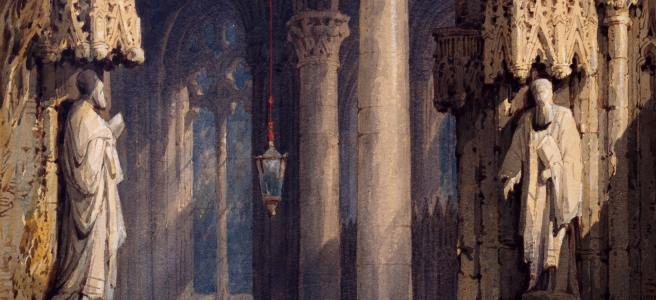
I sometimes think doctrinal Christianity is like drug addiction. After growing up in the magisterial order of Christianity, glimpsing the vastness of a triune God and the revolutionary beauty of a self-sacrificing god-man, the secular world is a pale place by comparison. I feel a raging maw in the center of my core nothing else fills. No matter how good my life is — and my life is very good — there is an insatiable restlessness.
Continue reading “Can I Return to Christianity?”Category: Religion
War At the Christian Borderlands
For years, I existed at the borderlands of the Christian faith. My faith in the core creeds of Christianity was dying, but I continued to love the many streams of tradition, symbolism, story, and community. Most of all, I loved the person of Christ, even as he became more myth than man.
Continue reading “War At the Christian Borderlands”Thin Democracy and the Hunger For Meaning
Note: I have moved to Substack! Please subscribe to my work there.
In his book Defending Democracy from Its Christian Enemies, ethicist David Gushee argues that the liberal democratic tradition, which was pioneered during the Enlightenment and of which we are all beneficiaries, is “thin.” It gives us a negative vision of freedom, providing protections from impositions, but offers no positive, communal vision for the good life.
He writes,
This formative early vision is sometimes described as creating a “thin,” “liberal,” or “libertarian” democratic tradition. Its strength was its realistic recognition of the reality of convictional pluralism and the dangers of government meddling in matters of conscience so important to people that they will fight and die for their beliefs. Its weaknesses, however, were at least twofold. Its social imagination focused on individuals and their personal preferences rather than communities and their shared needs – but it is really communities that build associations and ultimately national governments. Further, its realism did not extend to recognizing that some shared accounts of the good life and the good community, and some way of forming good citizens who can exercise responsible freedom is required to sustain a viable human community – even a political community. Liberal democracy has been described as a “thin” tradition because of these missions.
Go read the founding documents of the United States, urges Gushee, and you will see that “these hugely influential documents offer relatively little by way of a shared communal vision.” These documents, Gushee argues, give lip service to the vague concepts of, “life, liberty, and the pursuit of happiness,” but make no effort to offer a clear definition of these terms.
Continue reading “Thin Democracy and the Hunger For Meaning”Why I am Not a Christian: The Problem with Fearing Godlessness
Note: I have moved to Substack! Please subscribe to my work there.
This is the third installment in my Why I am Not a Christian series. I invite you to read the other articles, but they are not necessary to follow what I will argue in this post.
- Why I Am Not a Christian: The Problem With Miracles
- Why I Am Not a Christian: The Problem With Experiencing God
One of the things that kept me from accepting my disbelief for so long was a fear of what the universe would be like without God. As Soren Kierkegaard wrote in Fear and Trembling:
“If there were no eternal consciousness in a man, if at the bottom of everything there were only a wild ferment, a power that twisting in dark passions produced everything great or inconsequential; if an unfathomable, insatiable emptiness lay hid beneath everything, what would life be but despair?”
Continue reading “Why I am Not a Christian: The Problem with Fearing Godlessness”Why I Am Not a Christian: The Problem With Experiencing God
Note: I have moved to Substack. Please subscribe to my work there!
This post is a continuation of my series on why I am no longer a Christian. In my last post, I explored how I came to doubt the core miraculous and supernatural claims of Christianity. I invite you to read that post, but it isn’t required to follow what I’m arguing for here.
Continue reading “Why I Am Not a Christian: The Problem With Experiencing God”I Left Christianity Because I Stopped Believing In It
NOTE: I have moved to Substack! Please subscribe to my work there!
In a recent article for The Atlantic, Jake Meador writes about the enormous decline in church attendance. He cites two reasons for the decline: abuse at the hands of the church and, most significantly, the structure of American life. Meador argues that our American culture of overwork squeezes people so much that the additional commitments of attending church just don’t feel feasible.
I have no doubt that Meador is describing a genuine phenomenon. Modern life is exhausting, and church, like all community, takes effort. Who wouldn’t prefer to sleep in on Sunday morning when you’ve spent the entire week at the office, stressing over bills, and taking care of your kids? “Workism reigns in America,” writes Meador, “and because of it, community in America, religious community included, is a math problem that doesn’t add up.” He’s concerned about this because church attendance is an important institution that correlates with general well-being:
Participation in a religious community generally correlates with better health outcomes and longer life, higher financial generosity, and more stable families—all of which are desperately needed in a nation with rising rates of loneliness, mental illness, and alcohol and drug dependency.
I agree with his concerns. I worry about the loss of institutions that contribute to human flourishing. But I want to point out another reason people stop going to church that is conspicuously absent from Meador’s article: they no longer believe the truth claims of Christianity.
Continue reading “I Left Christianity Because I Stopped Believing In It”On Being a Border-Stalker
In his book Testimony: Inside the Evangelical Movement that Failed a Generation, journalist and Christian Jon Ward writes about how he never felt completely at home in his conservative Christian environment. He writes,
Continue reading “On Being a Border-Stalker”All my life I have been a mearcstapa, or a border-stalker. Mearcstapa is an Old English word used in Beowulf. Painter and author Makoto Fujimura used this term, and his modern translation of border-stalker, to describe those who “are uncomfortable in homogenous groups” and yet are still present in them, and thus they live “on the edge of their groups, going in and out of them.
Resist Purity
In my recent conversation with Evangelical and multi-faith expert John Morehead, I asked him if, while having conversations with people he has strong disagreements with, he ever feels complicit in enabling beliefs that he feels are harmful or destructive to society. His answer is worth reproducing in full (edited for clarity):
Continue reading “Resist Purity”The Ravenous Need For Religious Order
Several weeks ago, a dear friend of mine told me, “I thought I could handle being an atheist. But I just can’t. The world is too terrifying without a religious structure. So I’ve chosen to go back to church, and go back to believing.” He said it with a downcast look of shame as if he was confessing something terrible. I didn’t think he was. I appreciated his honesty.
Continue reading “The Ravenous Need For Religious Order”Religious Language For Nonbelievers
Last week’s article The Nontheistic Experience of God provoked some good discussion within my community about meditation, spiritual experiences, and the use of the word “god”.
Continue reading “Religious Language For Nonbelievers”