

NOTE: I am moving to Substack! Please subscribe there.
I am an atheist, but I find myself resorting to religious and spiritual language because the alternative feels deeply impoverished. How does one communicate the pursuit of wisdom, self-transcendence, and contemplative insight without using the word “spiritual”?
Mystic and meditator Sam Harris writes of this in his book Waking Up:
Before going any further, I should address the animosity that many readers feel toward the term spiritual. Whenever I use the word, as in referring to meditation as a “spiritual practice,” I hear from fellow skeptics and atheists who think that I have committed a grievous error. The word spirit comes from the Latin spiritus, which is a translation of the Greek pneuma, meaning “breath.” Around the thirteenth century, the term became entangled with beliefs about immaterial souls, supernatural beings, ghosts, and so forth. It acquired other meanings as well: We speak of the spirit of a thing as its most essential principle or of certain volatile substances and liquors as spirits.
Using Harris’s insight here, I think it is useful to strip away all supernatural connotations of “spiritual” and instead see the word as signifying the most significant, central, and foundational things to human flourishing. To be spiritual is to pursue the most meaningful life and the greatest wisdom that can be attained. I believe that this requires a commitment to boundless compassion, self-transcendence, and shrewdness about human nature.
Harris goes on,
Nevertheless, many nonbelievers now consider all things “spiritual” to be contaminated by medieval superstition. I do not share their semantic concerns. Yes, to walk the aisles of any “spiritual” bookstore is to confront the yearning and credulity of our species by the yard, but there is no other term—apart from the even more problematic mystical or the more restrictive contemplative—with which to discuss the efforts people make, through meditation, psychedelics, or other means, to fully bring their minds into the present or to induce nonordinary states of consciousness. And no other word links this spectrum of experience to our ethical lives. Throughout this book, I discuss certain classically spiritual phenomena, concepts, and practices in the context of our modern understanding of the human mind—and I cannot do this while restricting myself to the terminology of ordinary experience. So I will use spiritual, mystical, contemplative, and transcendent without further apology. However, I will be precise in describing the experiences and methods that merit these terms.
I think we should get over our allergy to spiritual and religious language. Religion has provided us with a huge vocabulary for internal states and sacred pursuits, and there’s no need to reinvent the wheel. We can draw promiscuously from the mystical insights of world religions.
Readers had some interesting responses to last week’s article “The Bound and The Unbound”. Stu commented,
I’m redefining the term bound here, but one could say that Sam is still bound to spiritual practice in a general sense even though he’s not bound to any particular dogma. On the other hand, I think there are people for whom spiritual fulfillment of any formal kind is not a priority unless we’re really stretching the definition of spirituality to include things like love of music, art, sports, or anything one may experience in a profound way. Those are the people who I might describe as the truly unbound.
For Sam, one could argue that he simply hasn’t found (or founded?) a religion that matches his spiritual needs in a 1:1 manner. However, Sam’s cherry picking what works for him from various religious practices is, in many ways, a nontheistic religious practice in itself.
This perspective is one I’ve come to embrace within Satanism where, while there’s a focus on the character of Satan, it’s not a dogmatic or even necessary focus on Satan himself, but rather what he represents. In Satanism, people are free to tailor their spiritual practice in a highly unbounded way, much like Sam Harris has done. As an example, some Satanists incorporate Buddhist practices within their Satanism because it works well for them. Satanism can be a great religion for the types of people you’ve described as unbound. In fact, I still consider myself unbound because the difference for me is I’m not bound to my Satanism, my Satanism is bound to me.
One of the most interesting things to me about the Bound/Unbound dichotomy is hearing how other people relate to the concept. Some non-religious atheists have told me that they are Bound, while people who are clearly part of a codified religion (nondenominational Christians who eschew the label “religious” completely) consider themselves Unbound.
This points towards a clarification I wish I’d included in the original article: the Bound/Unbound classification has to do with how people perceive themselves, not with what is, in fact, true about them.
The more I think about it, I’ve come to believe that the Unbound position, while sincerely held, is often an illusion. My original conception of Bound/Unbound has to do specifically with religious identity, but when we expand the dichotomy beyond that, I think it is fair to conclude that everyone is bound by guiding narratives.
We all have overriding philosophies, principles, and assumptions about the world. When we truly examine these, we find that they often have names: Baptist theology for the nondenominational Christians who dislike labels, for example. Or nihilism, humanism, antinatalism, utilitarianism, materialism, etc. for secular people. If it can be examined, then it has been named, regardless of whether we call ourselves by those names or not.
This is not to say that all these labels are equally rational, irrational, or faith-based (they aren’t). But it is to say that they are all guiding narratives that can be named and examined. Just because we believe our particular worldview is neutrally true does not make it any less binding or nameable.
Gary had this to say in response to the article:
I also wonder if it’s possible to become truly unbound without having to study and deeply know what it’s like to be bound. Like, without the context of being bound, how would you really know what unbound is like?
I can imagine truly unbound ones being born in an environment without any religion or strong ideologies, no baggage. Which is great, BUT can they truly appreciate what it’s like to be unbound?
I’ve thought about this comment quite a bit over the past few days, and while it will probably rankle the Unbound, I think there is wisdom here. I believe that discipline is freedom, which means lashing myself to a particular post. For me, that post is secular Buddhism and The Seven Tenets of The Satanic Temple. The discipline of following a specific path has opened my horizons to enormous freedom, even if the path itself is entered through a narrow gate.
Special thanks to Gary Sanders, who is #1 on the leaderboard. Share Sacred Tension with friends and, if they subscribe, you rise on the leaderboard, get a comped subscription to paid content, and special gifts and shoutouts from me.
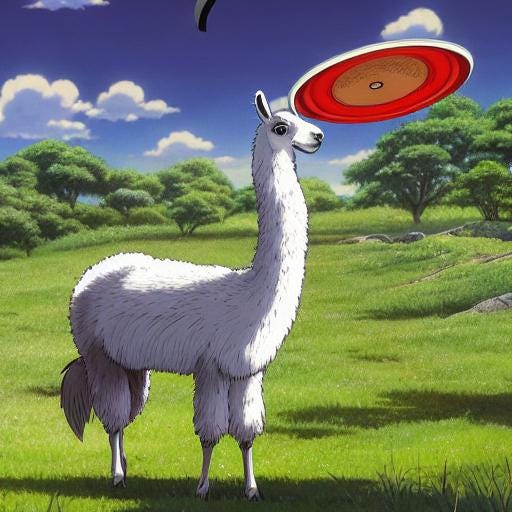
Gary, your gift this week is a llama who enjoys disc golfing. I hope you enjoy getting high together.
Share your thoughts, disagreements, and snide remarks below, and I might feature them in an upcoming post. Also, please consider becoming a paid subscriber and sharing this page with your friends.

 Stephen Bradford Long
Recently I have intentionally given up spiritual and religious language. I find it is confusing in conversations when in theologically mixed company, and the terms themselves while providing a vocabulary for describing experiences are no longer accurate in describing the experiences in a modern context. I have been interested in eliminative materialism and have started trying to describe the “spiritual” in terms of brain states rather than traditional mystical terms (mind, enlightenment, spirit, etc.). It’s been an interesting exercise.
LikeLike
Thanks for sharing! It’s interesting that we have differing intuitions on this point.
LikeLike